Olalla is one of the last genuinely rural communities with Puget Sound waterfront access in Kitsap County — under 150 homes, acreage that still exists, views of Vashon Island and the Cascades, and a community character that money can approximate but cannot invent.
Explore the Community
Olalla — pronounced "OH-la-la," from the Chinook Jargon word for "place of many berries" — is one of the genuinely rare communities left on the Kitsap Peninsula. Unincorporated, uncrowded, and largely undiscovered by people who haven't lived here. Fewer than 150 homes. Properties that sit on one to five acres of rolling hills, dense forest, and coastal bluffs. Homes that change hands between generations more often than they hit the open market.
The community sits on the hillside above Olalla Bay and the Colvos Passage — the quiet channel between the Kitsap Peninsula and Vashon Island that the old Mosquito Fleet steamships once used as a commerce route. On a clear day from the water-facing properties, you can see across to Vashon, south toward Gig Harbor, and east toward Mount Rainier on the horizon. Bald eagles roost in the trees above the tideflats. Seals and otters work the passage below.
Olalla has a civic life that belies its size. The Olalla Community Club has operated since 1906. The Olalla Americana Music Festival has drawn regional and national artists every August for 30+ years. The New Year's Day Polar Bear Plunge brings the whole community together at the bay. The Olalla Bay Market & Landing — a gathering place since 1884, renovated and reimagined in 2022 — has become a regional destination in its own right. And the Olalla Valley Vineyard & Winery, on six acres above the bay, hosts Tuscan-style farm dinners and Friday night live music against views that justify every penny.
This is a community where homes are passed down, not flipped. Where people come to stay. Where the value isn't in the square footage — it's in the irreplaceable combination of land, water, privacy, and proximity to everything that makes the Pacific Northwest worth living in.
"This nearly forgotten corner of Kitsap County has come into its own as a micro-destination and a must-visit for those eager to venture off the beaten path."— Tideland Magazine
Olalla is not a destination town with a main street full of shops. It's something better: a handful of genuinely distinctive places embedded in a rural landscape — each one worth the drive, each one the kind of thing you describe to friends and watch their faces change.
The community's gathering place since 1884 — renovated by local true crime bestselling author Gregg Olsen and reopened in 2022 as something genuinely special. Equal parts market, museum, cafe, and pizzeria. Historic relics and memorabilia from Olalla's past cover the walls. House-made sourdough pizza launches at 3 PM. Wet Coast Brewing on tap, Olalla Vineyard wines available, waterfront patio with views of the bay and Mount Rainier. The boat launch is next door — on summer weekends, people arrive by water.
Six acres of fantastical beauty on a promontory above Olalla Bay — Pacific Northwest wines, views of the Sound and Vashon Island, and a tasting room with old-world charm. Wine flights run $15/person. Guided tastings with gourmet charcuterie are $45 per person (minimum six). Friday evening live music runs through the season. The signature event is the Tuscan-style outdoor farm-to-table dinner held June through September, where local chefs pair food with house wines against a backdrop that stops mid-conversation. Reserve well in advance.
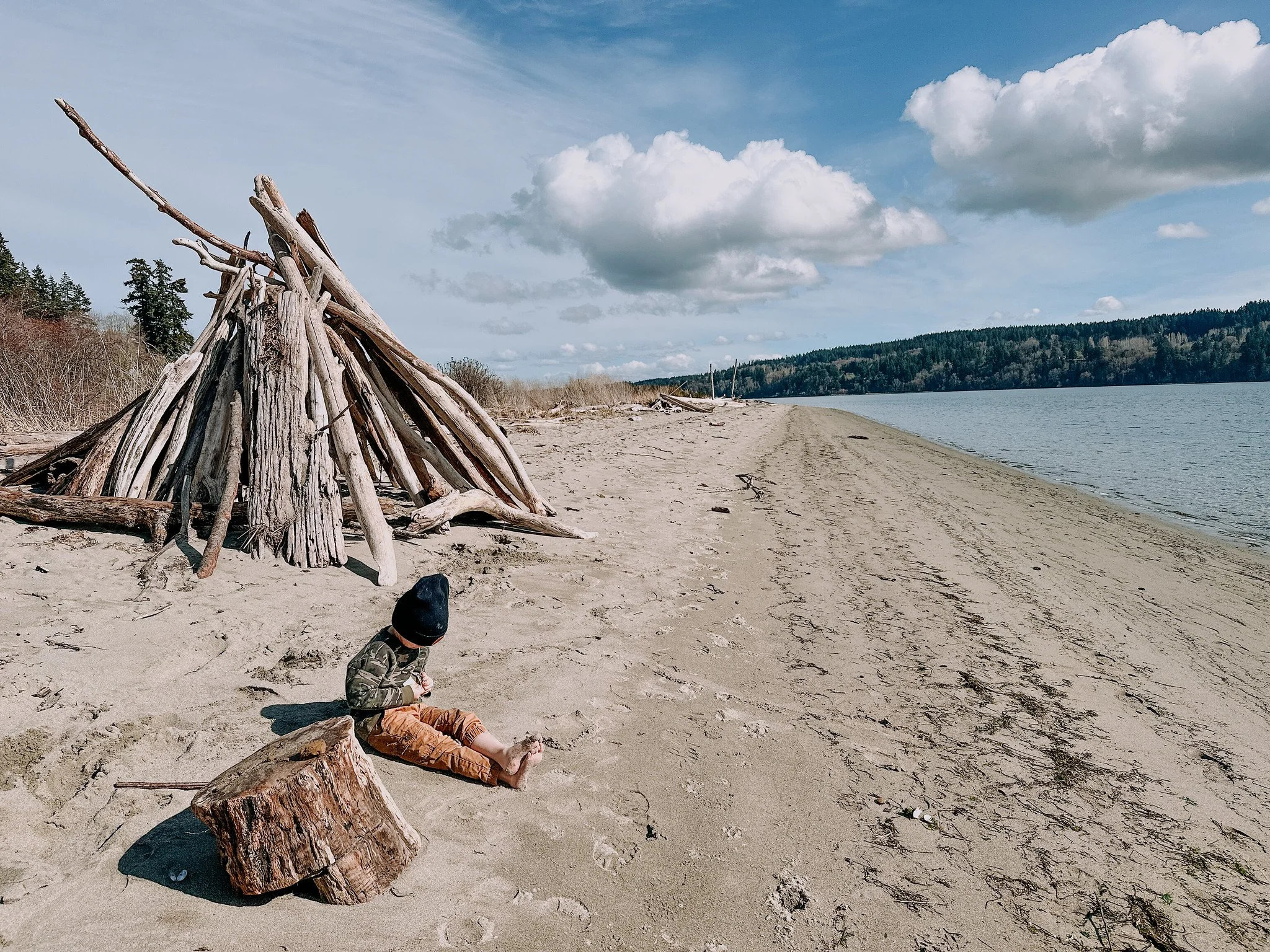
The gem of Olalla — a nearly mile-long hike down to a sand-and-gravel beach on Colvos Passage with unobstructed views of Vashon Island, the Olympic Mountains, and Mount Rainier on clear days. Oysters, clams, and moon snails in the tideflats. Seals, otters, and eagles are routine sightings. The beach is genuinely wild — no lifeguards, no facilities beyond picnic tables, no crowds on weekdays. Named for Ole Anderson, a Norwegian immigrant who settled here in the late 1800s. This is the Pacific Northwest beach experience most people have to drive much farther to find.
A 635-acre forested park five miles north of Olalla with over 29 miles of multi-use trails shared by hikers, mountain bikers, and equestrians. Dense second-growth forest, multiple stream crossings, and a trail network detailed enough that regular visitors still discover new routes. Horses are common — Banner Road sees regular equestrian traffic from riders using the forest as their backyard. For mountain bikers, it's one of the best trail systems in South Kitsap. For families, it's an easy afternoon in the woods without driving far.
Built by the Modern Woodsmen of America around 1906 and deeded to the community in 1937, the barn-shaped Olalla Community Club has been the civic heart of the unincorporated community for over a century. Potlucks, music nights, volunteer workdays, and the annual Olalla Americana Music Festival — now in its fourth decade — all center here. Membership runs $35–$100/year and covers upkeep of the hall. Moving to Olalla and joining the OCC is how you go from living here to belonging here.
Since 1991 — originally the Olalla Bluegrass Festival, now expanded to Americana and acoustic roots music — nine regional and national artists, food trucks, local artisan craft vendors, and the legendary berry pie baking contest that has run for roughly 30 years. The festival pulls visitors from across the peninsula and beyond, but it's still fundamentally a community event: neighbors volunteering, families setting up blankets, the kind of gathering that makes people understand immediately why Olalla holds onto its residents. The Olalla Lavender Festival in July is a newer addition celebrating the valley's lavender farms.
The county boat launch at Olalla Bay sits on a tidal estuary teeming with birds and sits directly across the Colvos Passage from Vashon Island — an excellent launch point for kayaking, paddleboarding, and small-boat exploration. Olalla is a designated access point on the Cascadia Marine Trail, one of only 16 National Millennium Trails in the country. The trail system has 50+ campsites including Lisabeula on Vashon Island, just a paddle away. At low tide, the estuary becomes a remarkable mudflat ecosystem. Sailboats cannot pass the bridge — this is small-craft and paddle-craft territory.
In the 1910s, Dr. Linda Burfield Hazzard operated a "fasting sanitarium" on the Olalla hillside that resulted in the starvation deaths of up to 12 patients and her eventual murder conviction in 1912. The case briefly put Olalla on the world's front pages. Local bestselling true crime author Gregg Olsen wrote the definitive account in Starvation Heights (available at the Olalla Bay Market). The site of the original sanitarium is still on the hillside. For true crime enthusiasts, ghost hunters, and history buffs, it's one of the most compelling dark history stories in the entire Pacific Northwest.
Ten minutes from Olalla, the Southworth ferry terminal offers two Washington State Ferry routes: direct to Fauntleroy (West Seattle) in approximately 30 minutes, and to Vashon Island in 15 minutes. The Fauntleroy route provides car and passenger access to Seattle without navigating the highway-to-ferry route through Bremerton. For Olalla residents with Seattle employment, this is the commute route — and it's one of the more pleasant ferry crossings in the region, running through the Colvos Passage that literally borders the community.
Olalla real estate operates by different rules than the rest of Kitsap County. Fewer than 150 homes exist in the community. Properties are regularly passed down through families rather than listed on the open market. When homes do come available, they tend to sell quickly — often in under two weeks — because the pool of buyers who understand the value proposition acts fast.
The price range reflects both the scarcity and the quality. Ranch-style homes from the 1960s on one to five inland acres list between $640,000 and $820,000 depending on water view. Early 2000s Cape Cods on five or more acres start at $960,000 and reach $1.6 million for properties directly overlooking the Colvos Passage and Vashon Island. The median sale price has tracked strongly upward — recent data shows medians above $1 million, with year-over-year appreciation in the double digits.
Olalla is not a community you buy for investment yield alone. You buy it for land, privacy, views, and access to a way of life that is increasingly unavailable in Western Washington. An acre of wooded hillside property with water views, 10 minutes from a Puget Sound ferry, 20 minutes from Gig Harbor and Port Orchard, and embedded in a genuine rural community with 120 years of civic history — there is no other version of this available in the region at any price.
The hillside topography means most properties are naturally protected from tidal flooding. The elevation provides the views. The combination of forest cover and rural road infrastructure provides the privacy. For buyers who have done the calculus on what quality of life actually costs, Olalla makes sense in a way that surprises people who haven't spent time here.
Olalla moves at a pace that the Pacific Northwest used to move before everything got optimized. The morning you realize you're watching an eagle work the tideflats from your kitchen window while Mount Rainier sits on the horizon behind it — that's the morning you understand why people don't leave.
Thursday through Sunday, the market is the town's living room. Sourdough pizza, local beer and wine, a waterfront patio, and the kind of crowd that forms when a small rural community finds its gathering place again. Gregg Olsen's renovation turned a dilapidated building into something people drive from Gig Harbor and Port Orchard to visit. For Olalla residents, it's simply Thursday.
The Olalla Valley Vineyard & Winery has become a destination in its own right. Friday evening live music. Guided tastings with charcuterie. And the Tuscan-style farm-to-table dinners June through September, where local chefs bring their best to a vineyard overlooking Olalla Bay. For residents, this isn't a special occasion — it's what a Friday evening in Olalla can look like.
The Olalla Community Club has been here since 1906. Potlucks, music nights, volunteer workdays, the annual Americana festival. Membership is how you plug into the social fabric — it's low-cost, high-return, and the kind of institution that only exists in a community that has never lost the thread of itself.
The Olalla Americana Music Festival in August. The Olalla Lavender Festival in July. The New Year's Day Polar Bear Plunge in the bay. These aren't manufactured events — they're the traditions of a place that knows how to celebrate itself. The berry pie contest at the Americana festival has run for 30 years. These are the things residents mention when asked what they love most about living here.
Banner Forest's 29 miles of trails five minutes away. Anderson Point's wild beach a mile down the hillside. The Olalla Bay boat launch for kayaks and small craft. Bandix Dog Park nearby. The Cascadia Marine Trail accessible from the bay. For equestrians, Banner Forest's shared trail system is legitimate — horses on Banner Road are a routine sight, not a curiosity. The outdoor infrastructure of Olalla is quietly extraordinary for a community this small.
Olalla's agricultural roots are still visible. Small farms, berry crops, and kitchen gardens are part of the landscape. The Olalla Valley Farmers Market runs mid-April through mid-October with fresh local produce and handcrafted goods. Residents with acreage tend to use it — for gardens, animals, or simply the privacy that comes from having forest between you and the nearest neighbor. The average household income runs around $126K, and 86% of residents own their homes. This is a community of committed landowners.
"On the sand and gravel shores of Colvos Passage, nestled deep in the wilds of South Kitsap — a place that's as fun to say as it is to explore."
Olalla requires a car. That is the honest starting point. There is no transit, no walkable commercial district, no bike-to-work option. If that's a dealbreaker, Olalla is not your community. If it's an acceptable trade for land, privacy, and a waterfront community with genuine roots — read on.
The Southworth ferry terminal is 10 minutes from Olalla and offers two routes: to Fauntleroy/West Seattle (approximately 30 minutes) and to Vashon Island (15 minutes). The Fauntleroy route gives Seattle commuters a car-ferry option that deposits them in West Seattle — a short drive or bus ride to downtown. For hybrid workers doing three Seattle days per week, this math works cleanly.
The car option via Highway 16 over the Tacoma Narrows Bridge runs 20–25 minutes to Gig Harbor, 20 minutes to Port Orchard, and 30–40 minutes to Tacoma. Bremerton is 30 minutes by car with ferry access to Seattle from there as well. For workers with South Kitsap, Gig Harbor, or Pierce County employment, Olalla is an entirely reasonable commute base.
Olalla residents who make the commute work consistently describe the drive through the forested valley roads as the thing they'd miss most if they moved. Morning light through the Douglas firs on Olalla Valley Road. The descent to the bay. The ferry boarding in Southworth with Colvos Passage opening ahead. These are not commute penalties. They are, for the right kind of person, exactly why you live here.
"The morning drive through Olalla Valley Road to the Southworth ferry — through forest, past the bay, onto the water — is the thing Olalla residents describe when people ask why they stay."
Olalla is not a community for everyone. It's a community for a specific kind of person — one who values what's disappearing faster than what's being built. If that's you, here's why Olalla is worth understanding.